Presenting My Research at TCURC: Explaining Mathematical Proofs to a Broader Audience
Presenting My Research at a Conference
I recently had the opportunity to present my mathematics research at an undergraduate research conference, and it turned out to be one of the most rewarding academic experiences I’ve had so far. It was a great opportunity not only to share my work, but also to hear about projects from students across many different disciplines.
Undergraduate research conferences are interesting because they bring together people from fields that normally don’t interact much. You might walk past posters on biology, psychology, computer science, economics, or philosophy, all in the same room. That also means you must think carefully about how to explain your work to people outside your field.
For mathematics, that can be especially challenging.
Research Summary
-
Conference: Trinity College Undergraduate Research Conference (TCURC)
-
Field: Mathematics
-
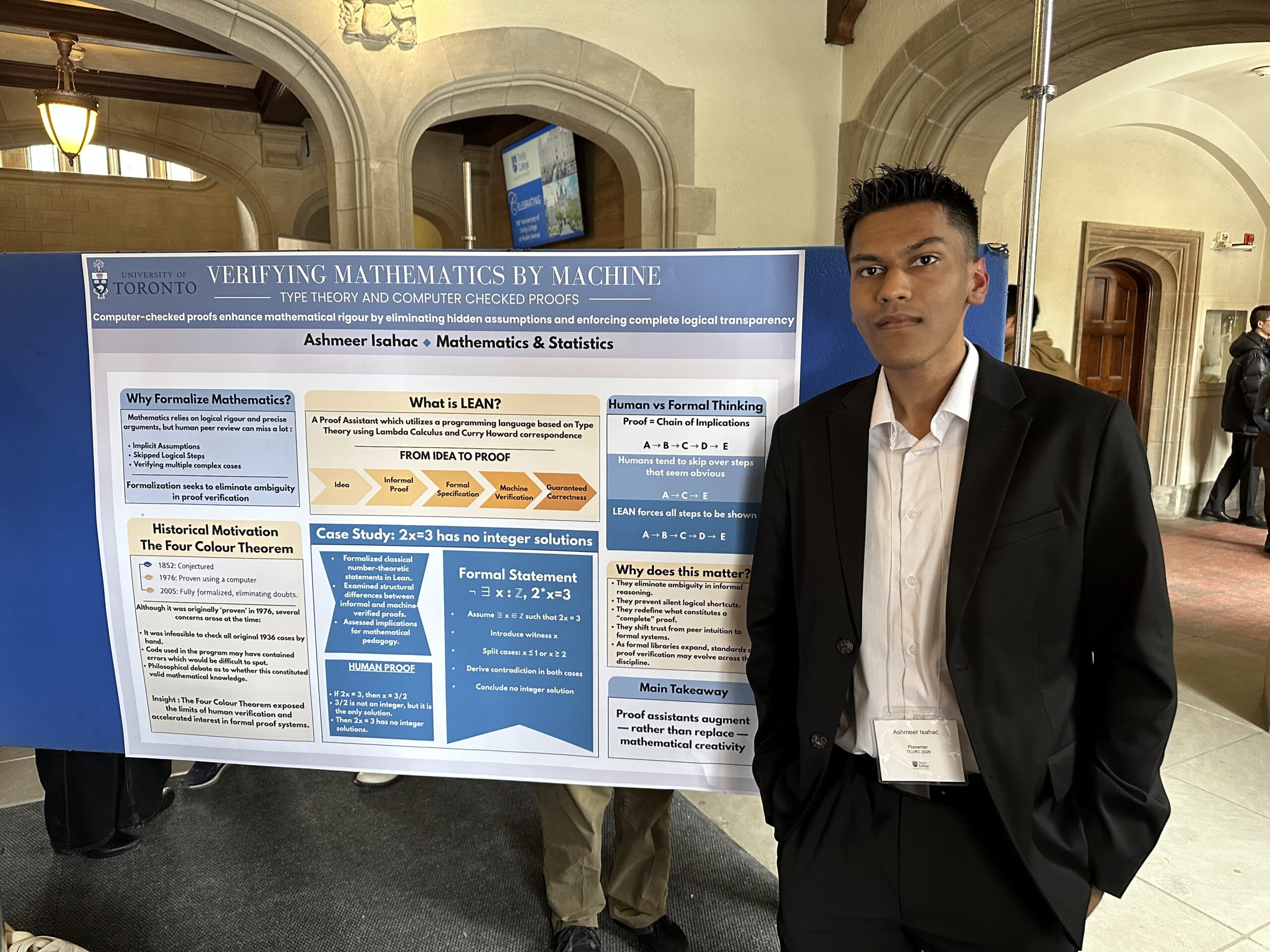
Topic: VERIFYING MATHEMATICS BY MACHINE – TYPE THEORY AND COMPUTER CHECKED PROOFS
-
Focus: Computer-checked proofs enhance mathematical rigour by eliminating hidden assumptions and enforcing complete logical transparency.
Explaining Mathematical Proofs to a General Audience
One of the questions I was asked during my poster session was how my research connects to fields beyond mathematics. A comparison I used was between mathematical proofs and essays.
In a typical essay:
• The thesis is the claim you want to support
• The body paragraphs provide evidence and reasoning
• The conclusion summarizes what you have demonstrated
A mathematical proof follows a very similar structure:
• The theorem is the statement we want to prove
• The logical steps support the argument
• The final statement confirms that the theorem has been proven
The key difference is that mathematics requires every step to follow strict logical rules. In that sense, proofs are essentially structured arguments built entirely on logic.
Because of this, the logical thinking developed in mathematics connects to many other areas, from computer science to the social sciences.
Explaining complex ideas clearly is an important skill in mathematics. I’ve also seen how valuable this is while teaching as a mathematics teaching assistant, where communicating logical reasoning to students is essential.
When Math Appears in Everyday Life
Another example I discussed during my presentation involved sphere packing, a classic mathematical problem known as the Kepler conjecture.
The question is surprisingly simple:
What is the most efficient way to pack spheres together in three-dimensional space?
The answer turns out to be the familiar pyramid-style arrangement you might see when oranges are stacked in a grocery store. This structure packs spheres together as densely as possible.
What makes the story fascinating is that although the conjecture was proposed in 1611, mathematicians spent centuries trying to prove it rigorously. Eventually, computer-assisted proofs and formal verification tools helped confirm the result. This means that something as ordinary as the way fruit is stacked in a store reflects deep mathematical reasoning.
As I joked during my presentation:
“So the next time you see a box of oranges stacked like that, math is the reason why.”
Conversations That Made the Experience Memorable
One of the most rewarding parts of presenting was the conversations with people who stopped by the poster.
Many asked thoughtful questions, including where research like this might go in the future. That question is actually harder to answer than it sounds, because mathematics often opens many different paths at once.
Research related to logic and proofs can lead to areas like:
• automated theorem proving
• formal verification of mathematics
• computer-assisted proofs
• connections with computer science and artificial intelligence
Thinking about these possibilities made me realize how broad the landscape of mathematical research really is.
Why Undergraduate Research Matters
Events like TCURC highlight the value of undergraduate research. They allow students to:
• share their work with a broader audience
• practice explaining complex ideas clearly
• receive feedback and new perspectives
• see how research connects across disciplines
For me, the experience reinforced something important: mathematics is not just about solving problems, but about communicating ideas and exploring possibilities. And sometimes, those ideas show up in places you might never expect, even in a box of oranges at the grocery store.
What I Learned from Presenting at TCURC
Presenting my research at TCURC reinforced how important communication is in mathematics. Explaining proofs to people outside the field required finding intuitive comparisons and everyday examples. Conversations with attendees also highlighted how mathematical logic connects to many different disciplines, from computer science to the social sciences.
Final thoughts
Presenting at TCURC was both exciting and rewarding. It was great to discuss ideas with people from different backgrounds and to see the wide range of research being done by undergraduate students.
Experiences like this remind me that research is not just about the final result, it’s about the conversations, questions, and curiosity that move ideas forward.