How to Understand Mathematical Proofs (Step-by-Step Guide for Students)
If you’ve ever looked at a mathematical proof and thought, “I have no idea what’s going on,” you’re not alone.
For many students, how to understand proofs is where math starts to feel completely different. It’s no longer about solving equations or getting a final answer; it’s about understanding why something is true, and that shift can feel confusing, frustrating, and sometimes even discouraging.
This is something I’ve thought about a lot, especially after presenting my research at TCURC, where I focused on explaining mathematical ideas to a broader audience. One of the biggest challenges isn’t the math itself : it’s how we approach understanding it.
In this guide, I’ll show you how to understand mathematical proofs step by step, using a practical approach you can apply to any proof-based course.
Quick Summary:
• Proofs show why something is true, not just that it is
• Focus on understanding each step, not memorizing
• Ask “why?” at every line
• Rephrase arguments in your own words
Why Do Proofs Feel So Hard?
The first thing to understand is that proofs aren’t supposed to feel easy at first.
Here’s why they often feel difficult:
• They’re not calculation-based
• Steps are often skipped or compressed
• They require understanding, not memorization
Unlike typical math problems, you can’t just follow a formula. Instead, you need to understand the reasoning behind each step.
And then there are different kinds of proofs, which can read more about here.
A key idea:
Proofs don’t just show that something is true, they show why it must be true.
What a Proof Is Actually Doing
One way I like to explain how to understand proofs, especially to students, is by comparing them to essays.
Think of a proof like this:
• Thesis: What you’re trying to prove
• Body: The logical steps that support your claim
• Conclusion: The final statement that confirms the result
Just like in writing, each step should follow logically from the previous one. If a step doesn’t make sense, the whole argument starts to break down.
This perspective makes proofs feel less like random symbols and more like structured reasoning. You can find a nice flow-chart I made for my TCURC poster involving proofs and human thinking.
Step-by-Step: How to Read a Proof
Instead of trying to understand everything at once, break proofs into smaller, manageable steps.
1. Identify the Goal
Start by asking:
What is this proof trying to show?
Don’t move forward until you’re clear on the end goal.
2. Understand the Assumptions
What are you given?
This might include:
• definitions
• known theorems
• initial conditions
Knowing what you’re allowed to use is crucial.
3. Break It Into Chunks
Don’t read a proof from start to finish in one go. Instead:
• read a few lines
• pause
• make sure you understand that section
Think of it like reading paragraphs, not a wall of text.
4. Ask “Why?” at Every Step
This is the most important habit. For each line, ask:
Why is this true?
If you can’t answer that, that’s where your understanding needs work.
5. Rephrase in Your Own Words
After reading a section, try to explain it simply.
If you can’t explain it, you don’t fully understand it yet, and that’s okay. It just tells you where to focus.
A Simple Example
Let’s look at a basic idea:
Claim: The sum of two even numbers is even.
Step 1: Start with definitions
An even number can be written as:
• 2a and 2b, where a and b are integers.
Step 2: Add them
2a + 2b = 2(a + b)
Step 3: Interpret the result
Since a + b still an integer, the result is of the form 2 times an integer, which means it’s even.
What matters here isn’t the result; it’s the reasoning.
At each step, you should be asking:
• Why can we write numbers this way?
• Why does factoring work?
• Why does this form imply the result?
That’s how you actually understand the proof.
Common Mistakes Students Make
If you’re struggling with proofs, chances are you’re doing at least one of these:
• Reading passively instead of engaging with the logic
• Skipping steps that feel “obvious”
• Memorizing proofs instead of understanding them
• Not questioning each step
These habits make proofs feel harder than they actually are.
How to Get Better at Proofs
The good news is that proof skills are learnable.
Here’s what actually helps:
• Practice writing your own steps, even if they’re messy
• Compare your reasoning to solutions
• Focus on understanding, not speed
• Talk through proofs with others
From my experience as a TA, one of the biggest differences between students who improve and those who struggle is this:
The best students actively engage with the logic instead of just reading it.
Why This Actually Matters
It’s easy to think proofs are just an academic exercise, but they build something much more important:
structured thinking.
The same skills used in proofs: clarity, logical flow, and justification, apply far beyond math:
• problem-solving
• decision-making
• communicating complex ideas
There are even tools like LEAN that formalize proofs to verify correctness, showing how this type of reasoning extends into computing and real-world systems.
Final Thoughts
Understanding proofs isn’t about being naturally “good at math.”
It’s about learning how to:
• break things down
• question each step
• think logically and clearly
It takes time, and it can feel uncomfortable at first, but that’s part of the process.
The more you practice, the more proofs start to feel less like a mystery and more like a structured way of thinking.
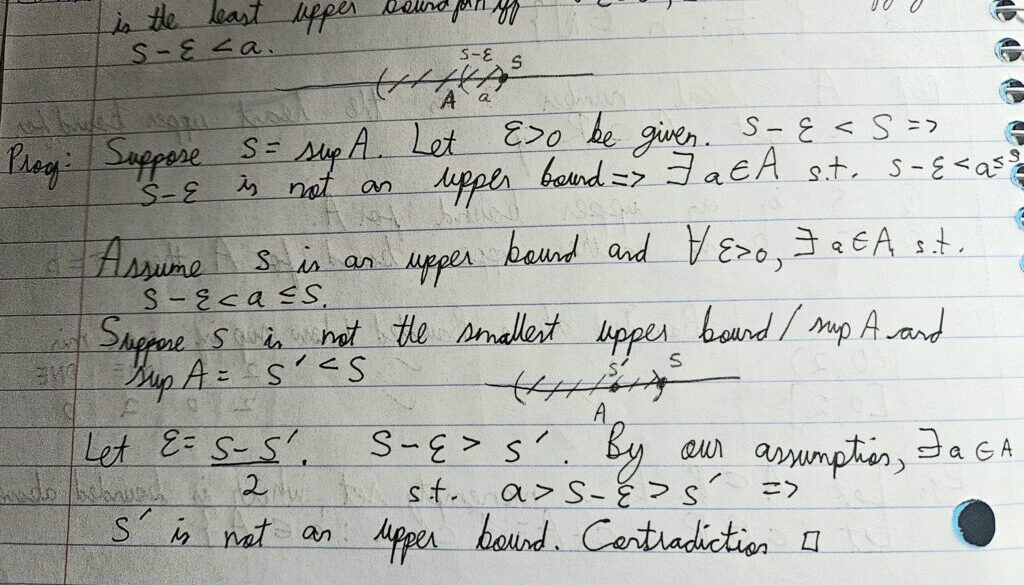
If you’re currently taking a proof-based course like MAT157 or similar, or just starting to encounter proofs, don’t worry if it feels difficult at first. I myself did not understand proofs fully until my second year.
You can read here about my experience in a proofs-based course here.
But that’s completely normal, and it’s something you can get better at.
Most people struggle with proofs not because they aren’t capable, but because they were never taught how to think through them.
Once you start treating proofs as a process instead of a mystery, everything changes.